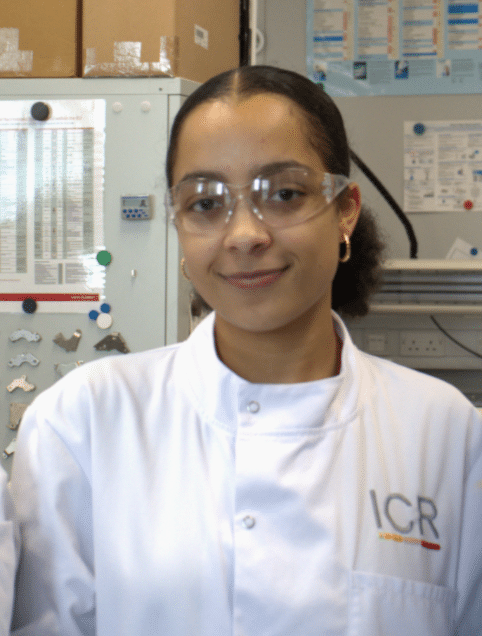
For National Apprenticeship Week 2026, Selene Manning, a Laboratory Technician at the Institute of Cancer Research (ICR), reflects on the benefits and learnings that their apprenticeship provided and the value that professional registration offers.
Selene was the winner of the Science Council’s 2025 Apprentice Ambassador Award – awarded to an individual who has shown exceptional dedication, professional excellence and a commitment to advancing science for societal benefit through their apprenticeship.
Apprenticeships give you real responsibility early on and shows you how your work contributes to a wider purpose, helping you grow personally and professionally.
Selene Manning
Can you tell us a bit about your work and what you do?
I completed a Level 3 Laboratory Technician Apprenticeship in the Structural Chemistry team within the Cancer Therapeutics Unit at the Institute of Cancer Research. In my day-to-day role, I support the team by preparing mobile phases for the LC-MS systems, troubleshooting and repairing instruments, training new users on our open access mass spectrometers, and running HPLC solubility and stability assays.
What motivated you to choose an apprenticeship, and how has it helped you build ‘skills for life’ so far?
I’ve always been someone who learns best by doing, so the apprenticeship route appealed to me as a way to gain practical experience in a real lab environment.
The ICR particularly attracted me because of its mission to defeat cancer, which felt personal to me after losing a close family member. So far, the apprenticeship has helped me build strong technical skills in chromatography and other analytical chemistry techniques, as well as transferable skills like communication, confidence, and teamwork.
Can you describe a moment in your apprenticeship where you realised you were developing skills that will stay with you throughout your career?
One key moment was when I redesigned our in-house HPLC solubility assay, moving it from a vial-based format to a 96 well plate format. This increased throughput, reduced waste, and enabled automation.
Being trusted to make meaningful changes to an established method made me realise how far my skills had developed and how these problem solving and analytical skills would stay with me long-term.
In what ways has your apprenticeship helped you grow beyond technical skills – for example, communication, problem solving, or resilience?solving, or resilience?
I developed stronger communication and teamwork skills through training new instrument users and working closely with my mentors and colleagues.
I also built resilience and confidence by overcoming imposter syndrome and tackling a steep learning curve in analytical chemistry through lectures, reading papers, and shadowing others.
Have you applied for/are you considering applying for professional registration? Why?
Yes, I am considering applying for professional registration through the Royal Society of Chemistry. I see it as an important step in demonstrating my competence, commitment to professional standards, and ongoing professional development. Professional registration would help formalise my experience, enhance my credibility within the field, and support my long-term career progression.
How do you see the skills you’re developing now supporting your future ambitions or career pathway?
My apprenticeship helped me discover a real passion for analytical chemistry.
I plan to continue building experience within the Structural Chemistry team and work towards a degree apprenticeship in the future, with the long-term goal of developing a career in analytical chemistry.
What support or guidance has helped you build lasting skills and confidence?
I had two excellent mentors who guided me throughout my apprenticeship, as well as a very supportive manager and team environment.
The ICR also offers many scientific and professional training opportunities, which played a crucial role in strengthening both my technical and transferable skills.
If someone asked you how an apprenticeship prepares you with ‘skills for life’, what would you tell them?
Apprenticeships help you build both technical skills, such as analytical techniques, assay development, and working with complex instruments and essential lifelong skills like confidence, communication, independence, and problem solving.
Apprenticeships give you real responsibility early on and shows you how your work contributes to a wider purpose, helping you grow personally and professionally.
Become professionally registered
Have you been inspired by Amin to explore professional registration? Find out more about our shortened application route for apprentices.